



Indexing
Page for creating the search index.
Building the index is heavy, so it is split into many requests sent via Ajax in a loop.
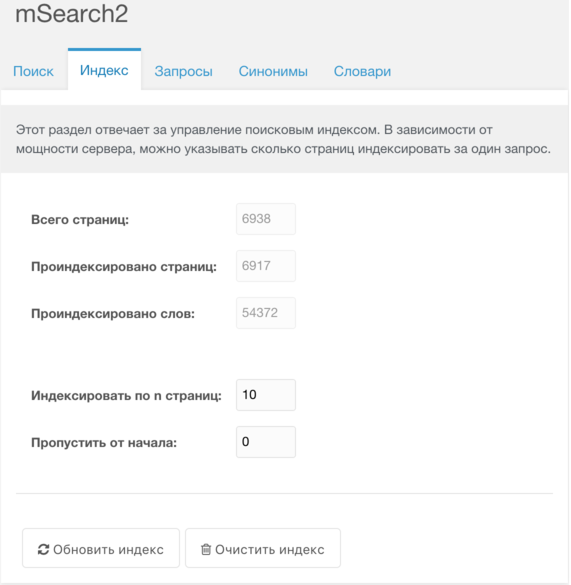
You can set how many resources to index per batch. 10 is a good default. If you get timeout errors, lower this value.
According to system settings, resource columns are loaded from the DB, split into words, and word forms are generated via phpMorphy and saved to the index table.
System settings
| Name | Default | Description |
|---|---|---|
| mse2_index_comments | true | Index Tickets comments |
| mse2_index_comments_weight | 1 | Search weight for words from comments |
| mse2_index_fields | content:3, description:2, introtext:2, pagetitle:3, longtitle:3 | Resource fields to index. Field name and weight separated by colon. |
| mse2_index_min_words_length | 4 | Minimum word length to index |
The main setting is mse2_index_fields; it sets how much weight words in each field have.
How it works
Each index row contains the word, its weight from settings, and the resource where it was found.
A special algorithm allows indexing non-standard fields, e.g. miniShop2 product properties — just add them to the settings. miniShop2 can also expose data from msVendor with the vendor_ prefix, e.g. vendor_name for manufacturer search.
For TV parameters use the tv_ prefix, e.g. tv_subtitle:3.
mSearch2 can index Tickets comments; the option is on by default.
So the site is split into many word variants that are used for search. Only resources with searchable (Participates in search) checked are indexed.
A bundled plugin keeps the index up to date on OnDocFormSave according to system settings.
Generate the index in the manager only when:
- Installing the component for the first time
- Changing indexing-related system settings
Adding custom words to the index
Sometimes you need to add your own words to a resource's index. From 1.5.2-pl you can use a plugin on mse2OnBeforeSearchIndex:
php
<?php
switch ($modx->event->name) {
  case 'mse2OnBeforeSearchIndex':
    $mSearch2->fields['my_field'] = 1;
    $resource->set('my_field', 'My Words');

    if ($resource->get('class_key') == 'msProduct') {
      $mSearch2->fields['product_field'] = 1;
      $resource->set('product_field', 'Product Property');
    }
    break;
}
In this example all resources get my_field with "WORDS" in the index ("my" is skipped due to min length), and miniShop2 products also get product_field with "Product" and "Property".
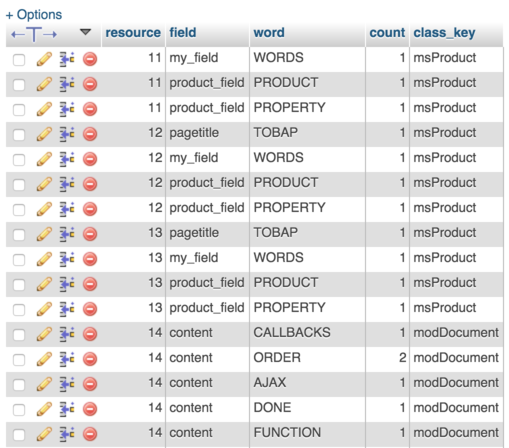
You can add any custom words to the index this way.
Indexing product options
Another use of custom words is indexing miniShop2 product options:
php
<?php
switch ($modx->event->name) {
  case 'mse2OnBeforeSearchIndex':
    $names = array(
      'option1',
      'option2'
    );

    foreach ($names as $key) {
      $mSearch2->fields[$key] = 1;
      $c = $modx->newQuery('msProductOption', array(
        'product_id' => $resource->id,
        'key' => $key,
      ));
      $c->select('value');
      if ($c->prepare() && $c->stmt->execute()) {
        $value = $c->stmt->fetchAll(PDO::FETCH_COLUMN);
        if (!empty($value[0])) {
          $resource->set($key, $value);
        }
      }
    }
    break;
}
You will need to handle parsing and saving for non-standard options if you have any.